en
en
 de
de
 ru
ru
 uk
uk
 es
es
Currency selection
The entire agricultural market on one website
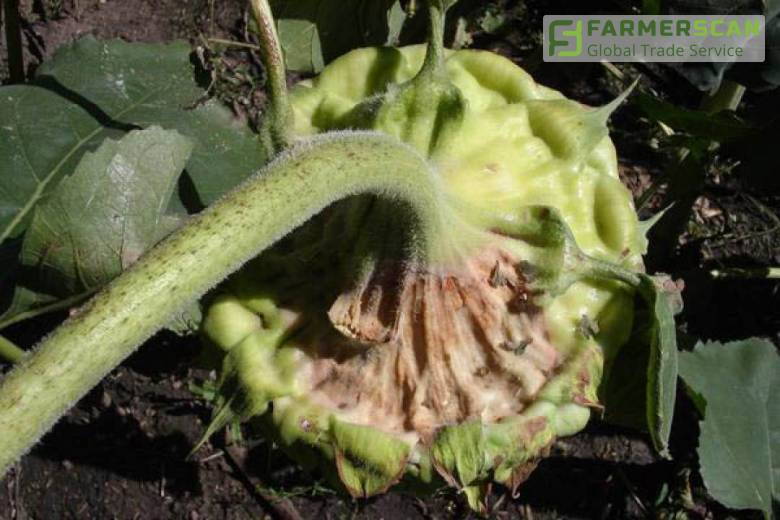
The rainy summer of this year, besides the positive influence on growth and formation of a crop, favored also mass development of diseases. According to estimates of farmers, about 15% of the sunflower crops are massively deseased by white and noble rot.
Bread and gray mold
The specifics of the development of sunflower diseases and the weather effects in this year was given by Candidate of Biological Sciences, Associate Professor of the Department of Mycology and Phytoimmunology of the Kharkov National University named after V. Karazin Alexander Akulov within the framework of the Agroplatform Limagrain in the Kirovohrad Oblast:
"This year, among head diseases predominate bread and gray mold. Visually, the diseases are similar, they are quite easily confused with each other. However, gray mold can be differed by ashy bloom on the blotch."
"Usually gray mold is a common, background disease that occurs every year, especially by the overcropping with sunflower. Bread mold occurs in certain years, because its development requires specific conditions. The first required factor is the presence of high humidity and high temperature. The second is the presence of fresh bruises on the plant. The disease penetrates the plant through fresh wounds, and, in order to avoid the spread of bread mold, it is necessary to protect the crops from pests. Therefore, the use of insecticides on sunflower is very effective against bread mold", adds the expert.


Vascular disease
"Another disease that is quite common this year is vascular disease. The fungus develops in plants, the vessels block up, the leaves fade, as a result, the plant wilt slowly. It is easy enough to determine it visually – in addition to the fact that the plant fades, another sign is necrotic spots, which are located between veins, while veins remain green. The systemic fungicide at the early stages allows to stop the development of this disease", says Alexander Akulov.


Septoria blight
Regarding septoria blight, the expert noted that this year there is practically no septoria, because at the beginning of the growing season the amount of precipitation was not enough. The obligatory condition for the development of this disease is large amount of precipitation at the early stages of plant development and moderate temperatures.
Taking into account the peculiarities of the development of sunflower diseases, Alexander Akulov recommended fungicidal treatments with the consideration of the weather conditions. If this refers to off year for the disease development, then it can be limited to one fungicidal treatment in the phase of asterisk.
When it is a case of rainy year, or on the lower leaves are already found the early signs of disease, then the phase of the asterisk should not be waited. In this case, it is necessary to apply a fungicide not later than during the phase of 6-8 leaves. Thus, well-timed control of diseases on the lower leaves will stop the development of infection at the early stages.