en
en
 de
de
 ru
ru
 uk
uk
 es
es
Currency selection
The entire agricultural market on one website
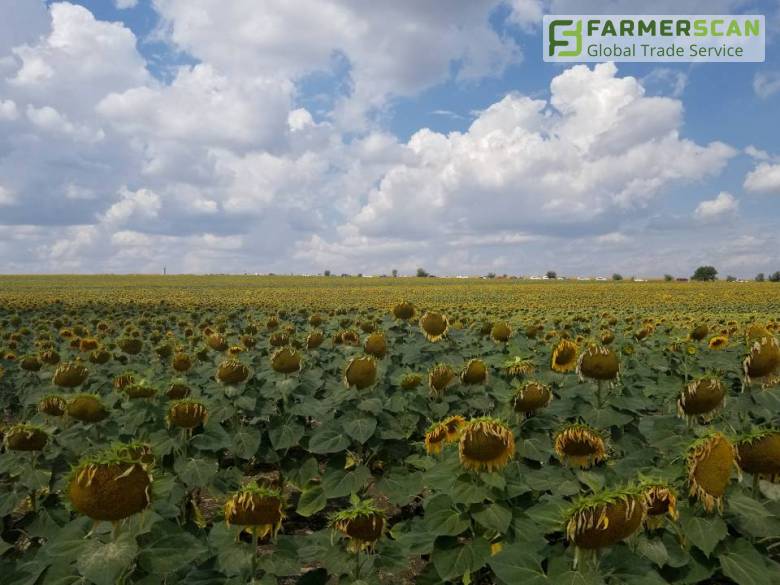
In addition to the understanding of the growing technology of each specific crop, its requirements for mineral nutrition and optimal seeding rates, it is equally important for an agronomist to determine the biological yield of a crop.
Experienced specialists are able to say by the appearance of the field, what amount of threshed grain is expected. However, in order to exclude the possibility of error by forecasting the yield, it is necessary to possess methods for calculating of biological yield.
In this article, we will talk about methods for the yield determination of one of the most popular crops in Ukraine, under which the cultivated areas are constantly expanding. Of course, we mean sunflowers. According to the State Statistics Service of Ukraine, the last three years this crop was sown on more than 6 million hectares or 20% of the total acreage. In such regions as Kirovohrad, Dnipropetrovsk, Mykolaiv, Zaporizhia and Kherson Oblast, the saturation with sunflower exceeds 30%.
Thus, calculations of the sunflower yield can be carried out in three ways:
Method 1: determination of the seed weight into sunflower head.
It is necessary to cut off 20 sunflower heads in the seed filling phase at least on 5 acreages. Further, sunflower heads must be threshed and the average seed weight of one sunflower head must be determined. The result should be multiplied by the density of planting, thousand/ha.
Method 2: determination of the diameter of the sunflower heads on the running meters of the row.
Depending on the planting width, the number of running meters is determined, on which the accounting will be maintained.
To calculate the number of running meters in one hectare, you need to divide 10,000 square meters into the planting width. For example, with inter-row spacing – 70 cm, the calculation will be as follows: 10000m²:0,7m=14285rm. Therefore, if the sowing was carried out with inter-row spacing – 70 cm, the calculations are carried out on 14.3 rm, if 52 cm – 19.2 rm, 45 cm – 22.2 rm respectively.
In 2-3 places along the diagonal of the field, the diameter of all the sunflower heads is measured on the required number of linear meters.
The experience has shown that the seed weight from one sunflower head of 12 cm in diameter come up to 20 g, 14 cm – 30 g, 16 cm – 40 g, 18 cm – 50 g.
Accounting of crop productivity is carried out by the formula:
Yb=Σm/100
Where:
Yb – biological yield, centner/ha
Σm – the sum of the seed weight from all sunflower heads on 14.3 linear meters of row, g
100 – conversion factor from g/rm in centner/ha.
Based on the seed weight in one sunflower head, the yield is calculated. After carrying out all accounts, the average value for each field is determined.
The second method is easier, but not so exact. After all, the actual correlation of empty and filled seeds in the sunflower head is not taking into account by such a method of biological yield calculating. The seed weight in the sunflower head is defined as the average value over the years and can not take into account the technology features, the amount of productive moisture and the weather conditions of the year, which significantly affect the filling and nature of the seeds.
If you have chosen the second method for accounting of crop productivity, for a more accurate result, we advise you to determine the weight of the seeds in the sunflower heads with different diameters.
Method 3: mechanized harvest from the test area.
A typical area is allocated on the field and mowing is carried out. By the selection of the area for carrying out of accountability, it is necessary to avoid beams, hills and tree belt areas, which adversely affect the reliability of measurements. The area, on which the sample will be selected, is calculated by multiplying the unit operating width (m) by the length of the unit passage (m).
Accounting of crop productivity is carried out by the formula:
Yb=M/S
Where:
Yb – biological yield, centner/ha
M – yield weight from the test area, centner
S – area, from which sunflower is harvested, ha.
The last accounting method is the most exact among the above-mentioned methods. Disadvantages include late terms for determination of crop productivity. In order to carry out quality threshing, it is necessary to wait for the economic maturity of plants. If the humidity was high, threshed seeds must be dried some more due to result of accountability.