en
en
 de
de
 ru
ru
 uk
uk
 es
es
Currency selection
The entire agricultural market on one website

For the formation of a powerful plant that will have yielding ability, corn needs nutrients, especially nitrogen. Thus, depending on the yield, corn uses from 100 to 300 kg/ha of nitrogen. As this element is very mobile in the soil and can be easily washed away with precipitations, the one-time application will be ineffective. The variable rate application by taking into consideration critical growth periods will help to reduce nitrogen losses and increase yielding capacity.
In this article the topic will be discussed, when the corn needs nitrogen, why and in what doses it is better to use a сarbamide-ammonia mixture.
Optimal application time
During the initial stages of development, corn uses only 5% of the required nitrogen. The period of intensive consumption begins during the phase of 6-8 leaves and lasts about a month before the beginning of flowering phase. At this stage, corn absorbs 85% of the total amount of nitrogen. At this time, the plants are actively growing and need a lot of nutrients. During the phases from 10 leaves to flowering, one plant absorbs on average 4 kg of nitrogen, 1 kg of phosphorus and 10 kg of potassium.
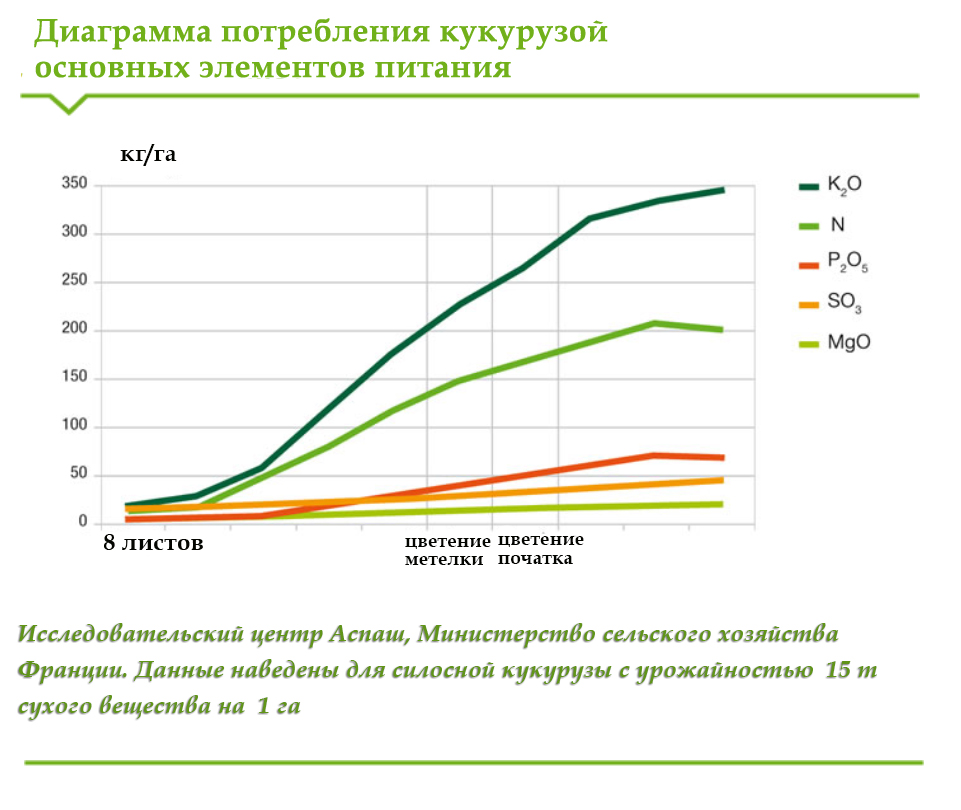
Based on the above graph, it can be concluded that during the initial stages of corn growth, only a starting dose of nitrogen is needed. It is enough to apply 40 kg a.i./ha to compensate the need for this element. This amount will be enough for young plants up to the phase of 10 leaves.
Nitrogen fertilization of corn is necessary during the growing season because of the high mobility of this element. So, 100 mm of precipitations wash nitrogen into the soil profile at a depth of 30 cm. Therefore, the applied fertilizers in autumn or even in spring will not be available to plants at the time of flowering. It is necessary to apply nitrogen fertilizers during the period from 4 to 10 leaves to ensure optimal nutrition of corn. The treatment will be optimal in the phase of 6-8 leaves.
It is especially important to carry out herbicidal protection measures before nitrogen fertilizer application, in order not to stimulate the growth of weeds. As the majority of postemergent herbicides for corn are applied in the phase of 3-5 leaves, the additional fertilization during the phase of 6-8 leaves feeds perfectly in to the protection technology.
Advantages of сarbamide-ammonia mixture
The сarbamide-ammonia mixture or CAM is the most popular liquid nitrogen fertilizer. It is a solution of urea [CO (NH2) 2] and ammonium saltpeter [NH4NO3], which contains from 28 to 32% of nitrogen. Depending on the concentration, there are CAM-28, CAM-30 and CAM-32.
Fertilizer has several advantages:
- three forms of nitrogen provide a prolonged effect of fertilizer for 10-25 days after application;
- low cost of nitrogen in the comparison with granulated fertilizers;
- flexible terms of application, it is possible to apply it in different phases of development;
- less dependent on the presence of moisture in the soil;
- overall application;
- convenient logistics and time savings on treatments;
- if it is necessary, the fertilizer can be combined with the application of herbicides or microelements.
The application method and rates
During the vegetation, corn crops are fed with the help of sprayers with pouring tubes or special machines for applying liquid fertilizers.
The application rate of fertilizers in the phase of 4-10 leaves depends on the planned yield and is 30-60 kg a.i./ha or 100-200 kg/ha of CAM-32. The recommended air temperature should be not higher than 20°C during treatments. Therefore, CAM is often applied at night to avoid the evaporation of nitrogen.
As the carbamide-ammonia mixture is applied into the inter-row spacing and not on the leaves, the treatment can be carried out with pure fertilizers without addition of water. However, it is important to avoid contacting of CAM and plants, otherwise necrotic spots or burns will appear. Insignificant damages of crops are possible by the application, especially on turnings and edges of the field. They are not harmful, and the plant will quickly grow after the rains. The main thing is that the CAM does not fall into the apical point, otherwise the plant will die.
Nitrogen declines
In conclusion, we would like to raise one of the main questions about сarbamide-ammonia mixture. It is generally believed that this fertilizer cannot be applied to the field surface, because a significant part of the nitrogen will dissolve. The argument for this is that the CAM consists for 30-35% of carbamide, which loses some nitrogen into the atmosphere by surface application. However, experiments have shown that nitrogen losses of CAS are much lower than nitrogen losses of granular nitrogen fertilizers: they do not exceed 10% of total nitrogen, while they reach 30-40% by granular fertilizers.
The treatment before the rain will help to avoid losses. After all, if 20-30 mm of precipitations fall after fertilizer application, the fertilizer will be washed into the soil to the required depth.