en
en
 de
de
 ru
ru
 uk
uk
 es
es
Currency selection
The entire agricultural market on one website
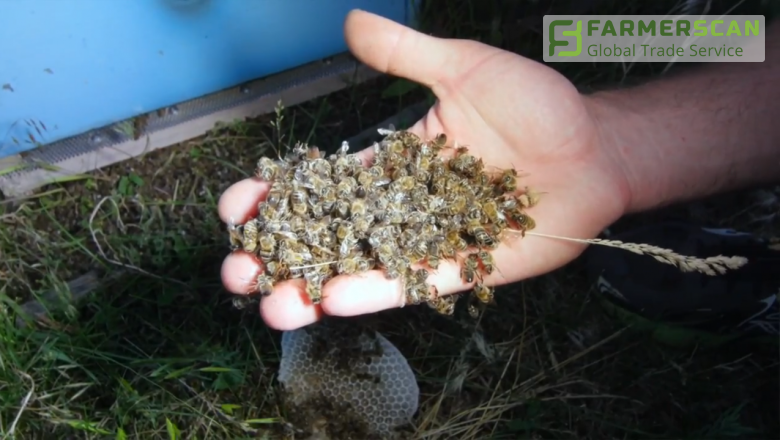
Last year, due to the using plant protection products, bees massively died out throughout Ukraine. The situation brought into the public eye and led to a number of changes.
Since March 1, beekeepers can insure bees for the first time. This service is provided by insurance company "Brokbusiness". Price of the service is about 200 UAH per season and concerns all diseases of bees, cases of theft, fire, natural disasters or sudden poisoning. According to representatives of the insurance company, it will stimulate the development of beekeeping in Ukraine and will help to compensate for losses in case of unforeseen situations.
At the same time, the Verkhovna Rada registered the proposed law No. 10052, which should oblige private individuals and legal bodies to inform beekeepers about the use of plant protection products or agrochemicals on the fields. The beekeepers must be informed via SMS, whose beeyards are located at a distance of at least 10 km from the place of treatment. Beekeeper should receive information about spraying no later than 3 days before the start of it. The message should contain the date, time and place of treatment, the name of the plant, the agrochemical preparation, the period of validity and the level of danger to the bees. In addition, the treatment can only be carried out from 21.00 to 5.00, when insects do not fly.
Extinction
According to expert estimation, about 45,000 bee-families died in 2018 due to low-quality pesticides and rules breaking of fields treatment.
Vitalii Sholin, a beekeeper from the village Tsvitne, Oleksandrivskyi Raion, Kirovohrad Oblast, spoke about last year’s negative experience.
“I have a small beeyard – only 20 beehives, three bee-families had completely died out, they just had not returned. Ten bee-families are weak, and it is unknown, whether they can overwinter. Other beeyards in our village were also harmed. In general, about 90% of the beekeepers in the Raion took losses.”
In addition to bees, Vitalii Sholin's family was also harmed by pesticides. The beekeeper tells that after the spraying nearby of his household, the whole family felt themselves unwell. They had to go to the hospital with complaints of unwellness.
As Vitalii Sholin said, he managed to attract the attention of state bodies to the case of rules breaking. To do this, beekeepers called the hot line of regional state administration and several times called in the sanitary epidemiological station, which registered rules breaking during pesticides treatment. As a result, several farmers were forbidden to spray the fields.
At the same time, cooperation between farmers and beekeepers should bring significant profits to both parties. According to research data, the plant pollination with the holding of agrotechnical measures can increase the yield of sunflower by 50%, fruit crops – by 30%, and cucurbits and vegetable – by 40-160%.
Fall-off in honey export
At the end of 2018, experts noted a fall-off in honey export by 30% in comparison with 2017. FAO National Consultant Anna Burka believes that the fall of sales volume is caused by several factors.
“For 11 months of last year, 41.7 thousand tons of honey with a total value of $ 83.6 million were exported from Ukraine, which is 32% less than during the same period last year. In 2017, Ukraine earned 133,8 million dollars for record export volumes. Now we do not even expect such results. The fall-off in export was influenced by the mortality of bees and the low price of honey on the world market. Because of this, many beekeepers have kept their production until the price increasing,” said the specialist.
In Ukraine, about 80 thousand tons of honey are gathered yearly, half of which is exported. The main countries-buyers of Ukrainian's honey are Germany – 27%, Poland – 18% and the USA – 13%. Together with China and Argentina, Ukraine is one of three biggest world exporters of honey; however, significant differences in the volume of honey exports can form an image of an unreliable partner and threaten losing of long-term contracts.
Experts’ opinions
The members of the Ukraine Association of Beekeepers worry about possible situation repeating in this season. The breaker will be threatened with a penalty for spraying the fields with insecticides or treatment near settlements without warning. At the same time, proving the farmer’s guilt is problematic due to the difficult gathering of evidence base and other hindrances.
“Sometimes agricultural producers even threaten beekeepers. In one of such situations, we monitored the situation and obtain compensation to twelve beekeepers”, said the executive director of the Union, Tatiana Sushko.
The fundamental propositions about fields spraying and beekeepers informing are set out in the Beekeeping Act of Ukraine.
“According to the instructions of 1979, to prove the bee's plague, it is necessary to conduct a laboratory examination, which is possible only in Kyiv and Odessa. It is necessary to gather 200g of bees for this, and it is a whole package! Bees often die on the fields and do not fly to the hives, so it is very difficult to gather them. Now we develop a new passport form of beeyard. It can be used in court as evidence. It will look like a magazine, where all movements of hives and their number at the time of death will be pointed out”, said the executive director of the Union.
The Ukraine Association of Beekeepers also obtains to simplify the procedure of compensation and compulsory civil insurance of agricultural producers in case of any environmental and population poisoning.
According to Tatiana Sushko, insecticides of the group of neonicotinoids are the most threating for bees. A number of preparations, which are based on neonicotinoids, have been already forbidden for outdoor usage in the EU, Canada, the USA and China. Therefore, experts predict massive import of these insecticides to Ukraine at a reduced price.
“Now we are working with the Ministry of Environment on usage prohibition of neonicotinoids. We will predicate on the European experience in this case. It is clear that all interdicted preparations will be delivered to countries, where their use is allowed. Without appropriate changes, it will flow to us like water,” warns the expert.
The members of Association hope that the parliament will adopt changes in April or May, in this case the beekeepers would be more protected in the new season. Now a legal department was created, which deals with legal support of beekeepers.