en
en
 de
de
 ru
ru
 uk
uk
 es
es
Currency selection
The entire agricultural market on one website
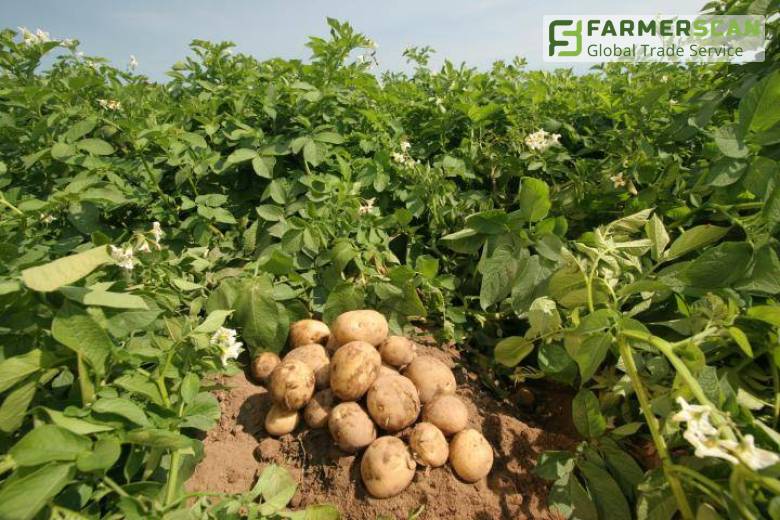
The use of fungicides for the treatment of seed potatoes or the preparations application into the soil creates a favorable phytosanitary conditions for plant growth.
The most common potato diseases are buck eye rot (Phytophthora infestans), early blight (Alternaria solani and A. alternata), crater rot (Rhizoctonia solani), bitter rot (Colletotrichum coccodes) and silver scab (Helminthosporium solani). The website Agribusiness Today told about the disease control with fungicides.
Crater rot develops under the conditions of wet and cold weather during the germination period. There are several forms: rotting of sprouts and shoots, the death of stolons and roots, dry rot of the creeping underground stem and the crater rot of the stems, on tubers – in the form of black scab, deep spots, cracks and reticular necrosis.
Bitter rot causes premature death of the stem and decay of tubers during the vegetation period and storing time. The disease is exhibited by premature shrinking or soaking of stems and the formation of a large number of sclerotia, black rot on shoots and roots, in the form of blackened wet or dry rot on tubers and black spots on their surface, as well as necrosis inside.
Silver scab reduces, first of all, the level of sprouting and the number of sprouts, it can spread the infection to its daughter potatoes. Even if there was no visible disease in the fall, by the end of the keeping period, the silver scab could reach mass development. The affected tissue of the potato is slightly pressed and has a characteristic metallic or silver luster; the skin begins to shrink, its permeability increases and, consequently, there is the desiccation.
By crater rot, bitter rot and silver scab, potato losses of seedlings reach up to 40% under certain conditions.
To prevent the development of diseases, the complex approach will help, namely the use of high-quality seed material, agrotechnical measures and the use of chemicals.
The use of fungicides during the bedding of potato reduces the risk of damage by ground pathogens. Today in Ukraine, 9 protectants are officially registered and there is one preparation for furrow application – Uniform.
Experiments on the effectiveness of the last preparation were carried out on the experimental fields of the Belotserkovsky research station, as well as on industrial crops of farms, which produce seed grains and food potatoes.
During the researches, the effect of several preparation with different content and combination of active ingredient was explored. There is one more variant, when the Uniform (azoxystrobin + mefenoxamine) was applied during the treatment of seed tubers by the trench planting.
Variants of research:
• Before planting, there were treatment with: fludioxonil + difenoconazole + thiamethoxam (Celest® Top) in the norm of 0.6 l/t.
• Before planting, there were treatment with: pencycuron + imidacloprid – 1 l/t.
• Before planting, there were treatment with: penfluten + clotianidin, 0.35 – l/t.
• Before planting, there were treatment with: Celest® Top 0.4 l/t with the use of Uniform® – 1.5 l/ha.
• Control variant (without treatment).
During the experiments, the number of sprouted tubers and the average number of stems in the bush were calculated. Disease affection was recorded in specific phases:
Experiments were carried out in 2015-2017, when the weather conditions contributed to the development of crater rot. The use of the above-listed preparations restrained the development of crater rot and increased the viability of tubers by 7.3-8.3% compared to the control variant. Fifty days after sprouting, affection with crater rot were noted on 23-29% of the stems on the control variant. With the preparation of preforcing treatment, affects were detected by 3.7-5.6% of the stalks. On the variants, where Uniform was applied, manifestations of crater rot were not noticed at all.
A decrease of affection by bitter rot was found only in the variant with the use of Celest® Top + Uniform, where the degree of affection was only 2.5-3.1%. On the land plots, this indicator was 11.5% with the use of the treatment agent Celest® Top 0.6 l/t. Affection of plants in other variants reached up to 32-34%.
In all variants, inhibition of development of silver scab on daughterly tubers was noted. However, the lowest harmfulness was observed by applying Celeste Top + Uniform®.