en
en
 de
de
 ru
ru
 uk
uk
 es
es
Currency selection
The entire agricultural market on one website
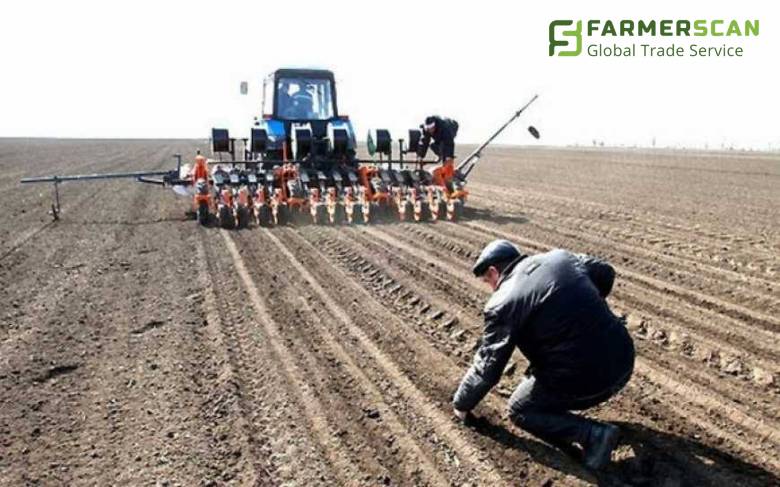
One of the key issues after beginning of seed drill's working is the quality of sowing. This indicator is especially important for wide-row sowings with expensive seeds, and yield depends to a great extent on the uniformity of the plants distribution in a row.
We offer a universal method of the seeding rate control, which works regardless of the culture and the planting width. It involves the counting of seeds number per running meter of the row.
The seeding rate on the seed drills is regulated mechanically or with the help of electronic controller. At the same time, using modern technologies, you should not neglect the traditional methods of accounting.
You need to know the row width to determine the number of running meters in one hectare. One hectare has 10,000 square meters, by which dividing on the appropriate rows, we get running meters. For example, for sunflower and corn with a row width of 70 cm, we get 10,000/0.7 = 14285 running meters.
Calculations of running meters for the most common row width are given in the table:
|
Row width |
Sowing crops |
Calculation |
Number of running meters |
|
12.5 |
Spiked cereals, rape, soy |
10,000 m 2/0.125 m = 80000 rm |
80,000 |
|
15 |
10,000 m 2/0.15 m = 66666 rm |
66666 |
|
|
30 |
10,000 m 2/0.30 m = 33333 rm |
33333 |
|
|
45 |
Sugar beet, soy, sunflower, sorghum |
10,000 m 2/0.45 m = 22222 rm |
22222 |
|
70 |
Corn, sunflower, soy, sorghum |
10,000 m 2/0,70 m = 14,285 rm |
14285 |
You can calculate the number of seeds per running meter knowing the seeding rate per one hectare. When sowing spring barley with a norm of 3.5 million/ha and row width of 15 cm, we get: 3,500,000/6,6666 = 52 pcs/rm
It is more convenient to count the number of seeds per one running meter for crops with a large seeding rate, such as wheat, barley, soy. Accounting of the sunflower and corn seeding rate is better to make on 14.3 running meters of the row. With a sunflower seeding rate of 70 thousand/ha, 70 seeds should be obtained at a given length.
To check the adjusted seeding rate of the seed drill, you can sow several meters without dipping the working tools of the seed drill in the ground to have the opportunity of seeds counting on the soil surface. Already sown row can be also unearthed and the number of seeds can be counted.
Different selective institutions give recommendations about the planting density, which are based on the characteristics of a particular variety or hybrid, soil preparation, and the soil and climatic conditions, under which the crop will be grown.
In addition to the recommendations of the manufacturers, it is necessary to take into account the sowing suitability of concrete seeds by determining the seeding rate.
For example, the recommended density of plant stand for corn is 65 thousand/ha, sowing qualities of seeds:
Germinating ability – 96%;
Purity – 98%;
Sowing suitability is determined by the formula: X=A*B/100,
where X is the sowing suitability, %,
A – purity of seeds, %
B – germinating ability, %
So, 98*96/100 = 94.08%
The physical norm can be calculated by the following formula: N = R*100/X
where N is the seeding rate, thousand/ha,
R – the recommended plant density, thousand/ha,
X – sowing suitability,%
As a result, 65*100/94.08 = 69.1 thousand/ha.
Accordingly, it is necessary to sow 69.1 thousand/ha to get 65 thousand/ha of corn sproutings. In equivalent to running meter, we get 4.8 seeds, the distance between which should be:
100 cm: 4.83 pcs./rm = 20.7 cm
The seed drill is regulated according to these indicators. To check compliance with the seeding rate directly in the field, it is necessary to calculate the number of seeds per 14.3 running meters, which should be in the range of 67-71 pcs.
Thus, knowing the density of sowing and the row width, you can check the seeding rate of most crops. This method is not suitable only for small-seeded crops, because it is impossible to control the amount of grains per one running meter of the row due to the small size of the seeds.
In addition, you can determine the degree of damage to crops by pests or infection by diseases, as well as conduct a visual assessment of contamination with the help of running meters.