en
en
 de
de
 ru
ru
 uk
uk
 es
es
Currency selection
The entire agricultural market on one website
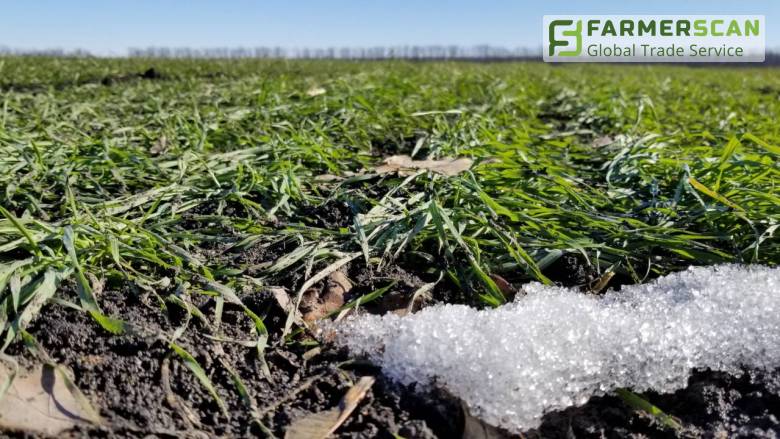
Winter had been already ending, so the topical subject is the condition of winter crops after wintering. Nazar Umrykhyn, the person in charge of the science and technology department of cattle breeding and crop research of the Institute of Agriculture of the NAAS steppe zone, spoke about the situation on the fields, as well as about the optimal rates of fertilization in spring.
As the scientist noted, last year the weather conditions were favourable for winter crops. Sufficient amount of rainfall in September contributed to good and equal sprouts. Winter crops, which were sown on the best forecrops, were in good bushy condition at the beginning of winter. Crops after forecrops with late harvesting time, such as soy of mid-ripening and late varieties, corn, sunflower, were in the sprouting phase – two or three leaves – at the time of the end of the growing season.
Wintering also passed in optimal conditions. A thick layer of snow reliably protected the plants against freezing:
"Since November 15, snow cover began to form in the region, the height of which was practically the highest in the central and northern regions in the last 20 years and in some places, it reached 70-80 cm", said Nazar Umrykhyn.
Critical temperatures for overwintering were not observed. Temperature at the tillering node depth did not fall below - 4-6°С, whereas the freezing of winter wheat occurs at -4-16°С and winter barley and rape – at -9-11°С.
According to the department of agro-industrial development of the Kirovohrad regional state administration, the majority of winter crops are in good and satisfactory condition, the thinned crops are found only on 8% of the area.
Assessment of winter crops state in the Kirovohrad Oblast as of 06.02.2019
|
Cropper |
Area, ha |
The state of crops, in percentage of the total area |
||
|
Well-conditioned,% |
Satisfactory,% |
Thinned,% |
||
|
Winter wheat |
317900 |
57 |
35 |
8 |
|
Winter barley |
71300 |
58 |
34 |
8 |
|
Winter rape |
59900 |
61 |
31 |
13 |
|
Winter rye |
400 |
50 |
50 |
|
|
|
||||
After monitoring the state of the fields, the decision is made to apply additional fertilizers or to reseed. To the main factors, which Nazar Umrykhyn advises to consider at the same time, the phase of development, uniformity and density of crops are included.
"If the density of plants, which were planted unevenly on the field, is less than 150 pcs/m², it is necessary to replant even well-developed crops. The cereals, which are at the beginning of the tillering stage, should be reseeded at density, less than 200-250 plants/m². In the seedling phase, the decision of reseeding is made, when the plant density is 350 pcs/m². It is also important to take into account the distribution efficiency of plants on the field.”
Regarding the phytosanitary condition, the scientist noted that we should expect the development of diseases. Since the snow cover was formed on the frozen ground, there is a high probability of crops rotting-out, especially in the early stages. Now the weather conditions are favorable for the development of fungal diseases. By the increasing temperature, these diseases will develop more intensively. Therefore, after monitoring the crops, most areas need to be treated with fungicides during the tillering stage, namely at the beginning of stem elongation.
The main agritechnical operation is additional fertilization for crops. The application of nitrogen during this period affects the number of productive stems and the number of flowers in the spike. Local farmers have already applied fertilizers, using spreaders, as well as looking for "windows", while the soil is sufficiently frozen and it is possible to enter the field. It is better to use ammonium nitrate or CAN for the additional fertilization on frozen soil:
"Nitrogen, which is in ammonium and nitrate forms, is most suitable for plants at first after the vegetation renewal. The amidic form of nitrogen, which is contained in carbamide and partially in CAN, has a long lasting effect and depends on environmental temperature. For example, at +4℃ plants will get nitrogen in 3-4 weeks and at a temperature of +20℃ – in 4-5 days."
Therefore, carbamide has a lower efficiency by early-spring application. In addition, it is necessary to take into account that by this fertilizer spreading on the field without embedding it into the soil, the nitrogen decline in the form of ammonia can reach 30-50%.
The scheme of application of early-spring additional fertilizers depends on the phase of plant development. First, weakly bushy crops are feeded.
“Nitrogen fertilizers should be applied on such fields. A fertilizer application rate of 100 kg/ha in the physical mass will be sufficient to stimulate spring tillering. The nutrition of crops, which are in the bushy state with a significant vegetative mass, is impractical on frozen-melted soil. The best way is to apply nitrogen fertilizers on such fields at the end of the tillering phase, as well as at the beginning of the booting stage. Since the surface soil is already dry during this period, it will be most effective to use root fertilization using seeders", the scientist advises.
The final amount of fertilizers needs to be corrected depending on the conditions of a particular household, the characteristics of agricultural machinery, crop varieties, soil type and other factors.