en
en
 de
de
 ru
ru
 uk
uk
 es
es
Currency selection
The entire agricultural market on one website
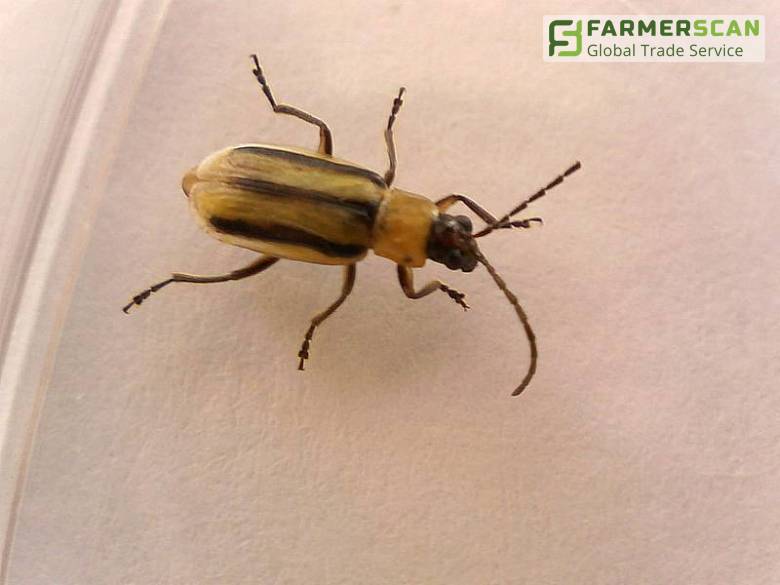
In recent years, the dangerous enemy of corn, the western corn rootworm, is becoming increasingly widespread in Ukraine. The Farmerscan team found out, how dangerous is this pest for agrarians, and what methods of struggle are the most effective.
Spreading
Western corn rootworm or diabrotica (Diabrotica virgifera Le Conte) is a quarantine pest from North America. In Ukraine, it was first discovered in 2001 in the Transcarpathian region, from where it began to spread rapidly across the country. In 2018, pest-affected fields were found in Kyiv, Kirovohrad, Mykolaiv, Odessa, and Cherkasy Oblast. We should expect further spread of the quarantine type in the central region of Ukraine, сonsidering medium speed of diabrotica spreading, which is 40-50 km per year.
According to State Service of Ukraine for Food Safety and Consumer Protection, as of January 1, 2019, the western corn rootworm was found in 15 regions of Ukraine. In 2018, new traces of the diabrotica spreading were found in Vinnitsa, Volyn, Zhytomyr, Ivano-Frankivsk, Rivne, Ternopil and Khmelnitsky Oblast. The total area, which is occupied by the pest, is 108,139.2 hectares, and over the past year these areas increased by 19,188.6 hectares.
Harmfulness
Damages, which are caused by the grown-up beetles and the larvae, lead to large crop and financial losses.
Diabrotica is a monophage pest that is fed with corn. Imago, which is 4-6 mm long, has light or yellow body with dark longitudinal stripes on the shards. The grown-up beetles skeletonize the leaves, browse the corncob tops and snouts of angiosperms. Damage of the generative organs leads to unseeded rye ear and the deterioration of the commercial quality of grain. In addition, beetles are carriers of chlorotic fleck and corn bacterial wilt.
The greatest damage of crops is caused by the larvae of the western corn rootworm, which are fed with the roots. After damaging, they become brown-red and are affected by root rot. Young plants wither and die out, but the stems of grown-up plants have a characteristic necking, deforming into a "goose neck". The damaged corn lodges and is easily pulled out of the soil. The amount of 25 larvae is enough for dying out of plant. It is worth noting that the larvae of western corn rootworm are fed only with corn roots and can move up to 50 cm in the soil. The larvae die out without nutrition, so the implementation of crop rotation is an effective way to control this pest.
Methods of control
The methods are divided into agrotechnical and chemical. These methods must prevent the spreading and localization, as well as destroy the identified local areas of the pest.
Agrotechnical methods
Compliance with crop rotation. Whereas the western corn rootworm is a monophagous parasite, the corn growing as a monoculture contributes to its development and distribution. The specialists of the State Service of Ukraine for Food Safety and Consumer Protection recommend sowing corn on one field not earlier, than in 3 years.
Survey of corn crops. The regular monitoring of crops is an important step to control the spread of the pest. The assessment of the field phytosanitary status should be carried out not only by specialists of the phytosanitary service, but also by agronomists and farmers, who grow corn. The special attention should be paid to areas with a high risk of appearing of this pest – fields near railway tracks, airports, as well as those fields that are located near areas, which are affected by western corn rootworm.
The method and period of the crop survey depends on the phase of pest development. The search for larvae is carried out in May-June, and for the grown-up insects – during the mass summer, which fall within a period from July to August. The examining of the root system of weakened and fallen plants is carried out for identification of the larvae. It is recommended to take samples from roots of such plants and from soil for phytosanitary expertise. The examining of the leaves, panicle and the corncobs is carried out for identification of the imago. The pheromone or glue traps are set up at the rate of 1 trap per 5 hectares.
- In the case of the finding out a western corn rootworm on the field, the complex of quarantine measures is carried out. The field should be plowed up again after harvesting. This agrotechnical action contributes to the death of pest eggs during winter soil freezing. It is forbidden to grow corn for three years on fields, which are affected by the western corn rootworms.
Chemical methods
It is recommended to apply pesticides against the western corn rootworm in two phases of its development – larvae and imago.
According to the State Service of Ukraine for food safety and consumer protection, there is the current list of pesticides and agrochemicals permitted for use in Ukraine (2018). The following preparations can be used against the western corn rootworm:
- Kaizo, VG (lambda-cyhalothrin, 50 g/kg) – spraying of plants during the growing season (1 treatment) at the rate of 0.3 kg/ha;
- Karate Zeon 050 CS, KS (lambda-cyhalothrin, 50 g/l) – spraying during the growing season (2 treatments) at the rate of 0.3 l/ha;
- Regent 20 G, G (fipronil, 20 g/kg) – application with subsequent embedding into the soil before sowing at the rate of 10 kg/ha.
Recommendations by "Syngenta"
Valerii Dubrovin, candidate of agricultural sciences, technical support manager of the company "Syngenta", told about the spread of the western corn rootworm in Ukraine to the team of the website farmerscan.com:
"According to experts of the company "Syngenta", the areas, which are occupied with corn rootworm, is about 160-170 thousand hectares. One generation of the pest develops during the season, although in the warm regions of North America two generations of the pest may develop during the season. The eggs can overwinter, of which larvae can appear in the spring, when the soil warms up to 11-13°C. The main number of larvae is located at the base of the plant at a distance of 10 cm from it. Since spring the larva has been damaging the soil, and then pupates, and the imago develops during the flowering of corn at the end of June."
Valerii Dubrovin singled out two ways to stop the spreading of the beetles: the first is aimed at destroying the larvae in the soil in the first half of the growing season of corn, the second – controlling the imago during the period of tasselling.
"The partial control of the larvae in the first half of the growing season is provided by tefluthrin as part of the protectant Fors® Zea due to the gas phase. The application of granulated insecticide Force ® 1.5 g is more effective by the sowing. The farmers of Hungary have a positive experience of application. They make a ready mix of fertilizers with insecticide Force® during sowing in order to protect crops against larvae of corn rootworm. This procedure simplifies the application, which is carried out with the usage of conventional fertilizer distributors and does not require the installation of applicators. This method is very effective", concluded Valerii Dubrovin.
The company "Syngenta" has the insecticides Karate® Zeon and Ampligo® to control the grown-up western corn rootworm. The maximum damage is done by western corn rootworm during flowering of corncobs, as beetles are very fond of juicy stems of female flowers. Therefore, it is better to apply insecticides during the period between the tasselling and the completion of flowering.
Foreign experience
The problem of the western corn beetle is topical in many parts of the world. Therefore, the team of the website FarmerScan sought advice from specialists from South America.
According to the experience of Argentinian agronomists, the best preparation against the larvae of the western corn rootworm is Corogen based on the active substance chlorantraniliprole (200 g/l) of the company "DuPont". It is recommended to use a protectant in the norm 1 liter of the preparation per 100 kg of seeds. Such an insecticidal treatment allows to protect the corn in the phase of 4-5 leaves.
The plants are sprayed with insecticides with the active substance gamma-cyhalothrin or lambda-cyhalothrin against a grown-up beetle during the growing season. The use of the preparations, which are based on chlorpyrifos or biphenthrin, is effective; however, such treatments will cost more.