en
en
 de
de
 ru
ru
 uk
uk
 es
es
Currency selection
The entire agricultural market on one website
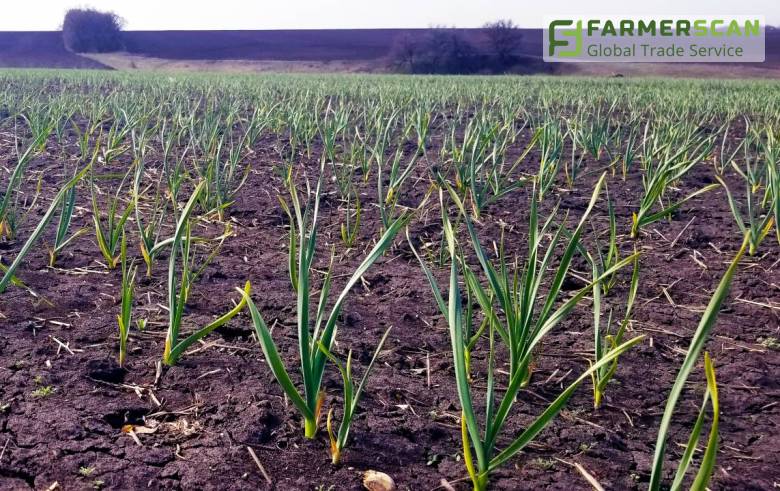
It is recommended to feed up garlic 3 times in spring to get the maximum yield. If mould or mineral fertilizers were applied before planting in autumn, additional spring fertilization is necessary. In case of a failure of basic elements, the garlic feathers will turn yellow, and the bulb will develop poorly.
It is important to apply additional fertilizers just in time during concrete phases of plant development. The fertilizers should contribute to yield increasing, rather than to herbage.
First application is held in a week after the snow melting. The active growth of garlic begins after the appearance of 6-8 leaves – the vegetative mass grows intensively, and the flower head is just formed. Nitrogen fertilizers stimulate the development of the aboveground parts of plants during this period. Strong plants will form a large bulb further.
If the weather is cool, it is better to apply ammonium saltpeter with a concentration of 20 g per 10 liters of water. Saltpeter contains ammoniacal and nitrate forms of nitrogen, which have a durable action.
If the weather is hot, it is better to apply carbamide, which works better at higher temperatures and is badly adopted by the plants at low temperatures. Additional fertilization is combined with irrigation, dissolving fertilizer in water. For this purpose you should use 20g of carbamide per 10 liters of water.
The second additional fertilization must be held in 2 weeks.
Intensive development of the bulb begins after the appearance of the 10th leaf. For this reason, it is necessary to apply nitrogen, phosphorus and potassium for full growth and development. Complex fertilizers, such as nitrophoska or nitroammophoska (ANP fertilizer), are suitable in the best way for the second application. 50-60g of fertilizer is dissolved in 10 liters of water, the discharge of the working mixture is 3-4 liters per 1m².
Third additional fertilization is necessary during the middle or the end of June. The bulb is formed during this period; therefore, the applying of phosphate-potassium fertilizer will be optimal. There is no need to apply nitrogen fertilizers because it worsens the storability of the bulbs and shortens the duration of the crop storage. During this period, it will be optimal to apply superphosphate. You should use 50-60g of fertilizer, dissolved in 10 liters of water, for irrigation and apply 4-5 liters per 1m². It is important to conduct the last additional fertilization timely. If fertilizers are applied before optimal term, nutrients are spent on the growth of feather mass and seedstalks. The treatment delay is also unprofitable, because it will not bring the necessary effects.
Harvesting of winter garlic is usually held at the end of July, the phase of ripening begins within 100-110 days from the moment of sprouting. You need to focus on the condition of the plants – the lower leaves should dry out, and the upper leaves should turn yellow. The main thing is not to hold over the garlic in the beds, otherwise the bulbs will easily break into chives.
The following of these recommendations and deadline fulfillment of additional fertilizations will allow you to get a high yield of winter garlic, which will be safely stored until January.